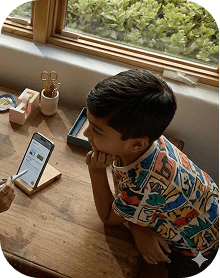
Most parents are worried about seeing their kids glued to screens. Knowing that there are uses of the internet that are helpful for their development, they may hesitate to question this. Many questions linger. Can "screen time" even be talked about as a single activity? Is there a daily time limit which can tell me if my child has a screen addiction?
The scientific answer is less dramatic than most headlines make it seem.
There is no single number that defines "too much" screen time. The American Academy of Pediatrics has moved away from strict limits for older children, encouraging families to focus on how screens fit into daily life. The World Health Organization still sets tighter boundaries for younger children, but even these are framed around balance, including sleep, movement, and rest.
This shift reflects what the research actually shows.
A large review by Russell Viner and Nina Stiglic found that higher screen time is linked with shorter sleep, higher body weight, and some mental health concerns. These effects exist, but they are usually modest. The strongest and most consistent finding is that late-night screen use can disrupt sleep, which then affects mood, focus, and overall wellbeing.
Research led by Sheri Madigan adds another layer. In younger children, very high screen exposure can affect language development and behaviour, especially when it replaces conversation, play, and real-world interaction. Screens are not inherently harmful, but what they displace matters.
This is why treating all screen time as the same can be misleading. Watching videos for hours is very different from attending an online class, using a study app, or catching up with family on a video call. As Candice Odgers has pointed out, the overall impact of digital use is often small and shaped more by a child's environment than by the screen itself.
At the same time, some caution is warranted. Jean Twenge has found that teens who spend more time on screens are more likely to report lower wellbeing. One of the clearest explanations is simple displacement. As screen time increases, it can eat into sleep, physical activity, and time spent with others, all of which are critical for healthy development.
This brings us to the idea of addiction, a term that is often used loosely.
In clinical terms, addiction involves a loss of control, distress when stopping, and continued use despite harm. According to the American Psychological Association, this is a high threshold. Most children who spend long hours on devices do not meet it. Research from Children and Screens suggests that what looks like smartphone addiction is often better understood as strong engagement with something designed to be engaging.
So where should parents place their focus?
Experts consistently point to patterns in everyday life. Is your child sleeping well and waking up rested? Are they able to focus on schoolwork without constant distraction? Do they still enjoy offline activities and time with family? These signals give a clearer picture of digital wellbeing than any single number.
It also helps to pay attention to the kind of screen use. Passive habits like endless scrolling are more likely to leave children feeling drained or distracted. More active uses, such as learning, creating, or staying connected with friends, tend to fit more comfortably into a healthy routine.
That is where thoughtful use of parental control tools can help. Not as a way to tightly restrict behaviour, but as a way to shape routines, create screen-free spaces, and support better habits around focus and rest.
In the end, screens are part of growing up today in more ways than we can consciously count. The goal is not to remove them, but to make sure they sit alongside the other essentials of childhood: sleep, movement, relationships, and unstructured time.
When those pieces are in place, screen use often settles into balance. But when that balance slips, something that began as a tool for connection can quickly become much harder to step away from.
References
World Health Organization (WHO) – Guidelines on physical activity, sedentary behaviour and sleep
American Academy of Pediatrics (AAP) – Screen time and family media plan resources
American Academy of Child and Adolescent Psychiatry (AACAP) – Screen Time and Children
Canadian Paediatric Society – Screen time and young children, 2017
Mayo Clinic – Screen time and children: How to guide your child
Stiglic, N., & Viner, R. M. (2019). Effects of screentime on health and well-being, BMJ Open
Madigan, S. et al. (2023). Effects of Excessive Screen Time on Child Development
Screen Time and Its Health Consequences in Children, 2023, PMC
Digital Screen Exposure in Children and Adolescents, 2025 review
Oxford Internet Institute – Przybylski & Weinstein research
Jean Twenge – Research on adolescents and screen use
Candice Odgers – Research on digital technology and adolescent wellbeing
UNICEF – Children in a Digital World
Harvard Center on the Developing Child
Children and Screens – Digital Addictions family guide
Jonathan Haidt – Work on social media and mental health
The Conversation –
What if our children are the screen-obsessed couch potatoes of the future?

.png&w=640&q=75)