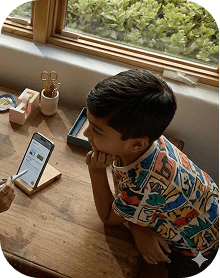
For Indian parents, this shifts the conversation from strict limits to balance. Children between eight and eighteen are growing up with technology as a constant companion. While it brings creativity and opportunity, it also raises questions about overstimulation, safety, and healthy habits.
Finding the right approach is not about cutting screens out entirely. It is about guiding children to use them well, with boundaries that support learning, wellbeing, and growth.
Blurring the Lines Between Learning and Leisure
Today, screen time is not limited to entertainment. Educational apps, online classes, and digital assignments are part of many children's daily routines.
But the line between learning and leisure can blur quickly. A child might begin with a school video or learning app and drift into gaming or social media before realising how much time has passed.
Rather than banning screens altogether, the focus is on helping children develop digital balance, understanding when it is time to concentrate, when it is okay to relax, and when it is important to step away.
How Much Screen Time Is Actually Okay?
Guidance around screen time has evolved over the years. Today, paediatric experts, including the WHO and Indian child health associations, emphasise that the quality of screen time matters more than the number of hours alone.
That said, having a general frame of reference can be helpful:
- Under 5 years: Mostly video calls and parent-guided viewing, with limited unsupervised use.
- Ages 6–10: Around 1–2 hours of non-school screen time, ideally shared or checked in on.
- Ages 11–18: About 2–3 hours of mindful use, balanced with offline activities, play, and hobbies.
It also helps to consider how screens are being used. Watching a science experiment or learning a new skill is very different from endless scrolling or passive consumption. Helping children recognise this difference and make choices accordingly is an important part of building healthy screen habits.
The Real Risks of Overexposure
Too much unsupervised screen time can have subtle effects over time on sleep, focus, mood, and emotional regulation. Children may seem more irritable, distracted, or restless, with the shift often being gradual and easy to miss.
Many apps and platforms are designed to hold attention. Features such as autoplay, notifications, and endless feeds use behavioural cues that make it harder for children and adults to disengage on their own.
Recognising these patterns matters. They are not a reflection of poor parenting or lack of discipline, but of digital environments that are not always designed with children's wellbeing in mind. Understanding this makes it easier to respond with structure, support, and balance rather than frustration.
Setting Screen Time Boundaries That Actually Work
Screen time rules tend to work best when they feel shared and predictable rather than sudden or punitive. Clear expectations, set early, give children a sense of structure they can rely on.
Simple strategies can help. Creating tech-free zones, such as during meals or at bedtime, builds natural breaks into the day. Agreeing on family rules together, instead of enforcing them unilaterally, helps children feel involved rather than restricted. Screen-time settings and parental controls can act as training wheels, offering guidance while children learn to manage their own usage.
Equally important is modelling balance. Children notice how adults use their devices, often more than what they are told. When rules are consistent and explained with empathy, children are more likely to understand their purpose and follow them over time.
Turning Screen Time Into Quality Time
Screens do not have to be a source of tension at home. When parents occasionally co-view or co-play, screen time can become a shared experience rather than a solitary one.
Watching a documentary together, exploring a learning or coding app, or solving puzzles on a device can create moments of connection. Approached this way, technology becomes a space for curiosity, conversation, and learning, not just consumption.
Teaching Digital Self-Regulation
As children grow older, especially between ten and eighteen, the focus naturally shifts from control to conversation. This is a good time to involve them more actively in how they use screens.
Encouraging children to notice their own screen habits, recognise when they feel tired or overstimulated, and take breaks when needed helps build awareness. Talking through the difference between passive scrolling and more active, purposeful use can also guide better choices. When children are included in setting boundaries, they are more likely to respect them.
Over time, digital self-regulation becomes a life skill, much like developing healthy eating habits or understanding the importance of regular movement, one that supports independence both online and offline.
Building a Healthy Digital Culture at Home
Creating a positive digital environment at home is less about getting everything right every day and more about finding balance over time. Some days will naturally be more screen-heavy than others, and that is okay. What matters most is consistency, open conversations, and shared responsibility.
Noticing and celebrating small wins helps. A week where gaming is balanced with outdoor play. A child choosing to put a device away on their own. These moments reinforce healthy habits without turning screen time into a constant source of conflict.
When families focus on balance, awareness, and communication, technology becomes easier to navigate. Children learn to enjoy its benefits while understanding its limits, growing into confident, responsible digital citizens who can make thoughtful choices both online and offline.

.png&w=640&q=75)