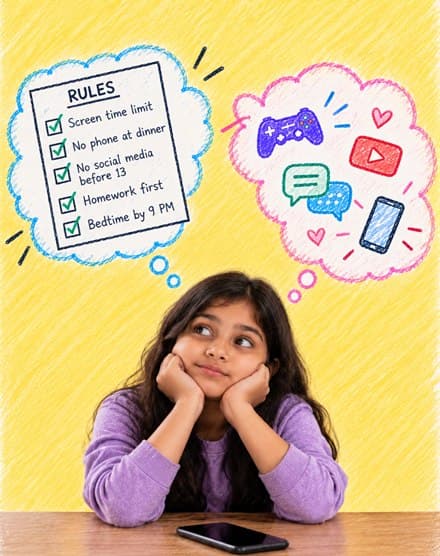

It's 8pm. Dinner is on the table, or homework is supposed to be happening, or it's simply time for the phone to go away. You say something. Your child doesn't respond. You say it again, louder this time. They say 'one minute.' You wait. Nothing changes.
You walk over, and what happens next is the same thing that happened yesterday, and the day before, and the day before that.
There is an argument. Voices are raised. Someone says something they don't mean. The phone eventually gets put down, or taken, and the rest of the evening carries the weight of it. You feel guilty, or angry, or both. Your child sulks through dinner. Nobody wins.
If this is your 8pm, you are not alone. You are not a bad parent. And you are not failing. You are fighting a battle that was designed to be unwinnable, and nobody told you the rules.
Why 8pm Specifically
The evening screen battle has a very specific structure. Your child has been in school all day: controlled, structured, offline for most of it. The moment they get home, the phone comes out. By 8pm, they've been back in their screen world for two to three hours. Their brain is deep in a dopamine loop: YouTube algorithm, a game mid-level, a WhatsApp conversation with friends that is still going. This is not casual use. This is neurological immersion.
Then you arrive, or dinner arrives, or homework deadline arrives, and you ask them to stop. What you're asking, from a neurological standpoint, is for them to voluntarily interrupt a reward cycle their brain is in the middle of completing. The anger and resistance you get is not defiance. It's a genuine biological response to an interrupted reward state.
The Three Mistakes That Guarantee the Argument
Mistake 1: The Surprise Shutdown
'Put the phone down. Now.' No warning. No transition time. Just an abrupt demand in the middle of whatever they're doing. To a child whose brain is mid-cycle in a reward loop, this is the equivalent of someone turning off a film they were watching at the most intense moment. The anger is almost automatic.
The fix is almost embarrassingly simple: give a warning. 'Ten minutes and then we're putting the phone away.' Then five minutes. This sounds like negotiating, but you're not. You're giving their brain enough time to begin disengaging before you ask them to stop entirely.
Mistake 2: Fighting About the Phone at the Moment of the Fight
The 8pm argument is the wrong time to have a conversation about screen rules. Both of you are in a heightened emotional state. Nothing productive comes out of a conversation that starts with 'you're always on that phone.'
Screen time rules need to be established at a calm moment, ideally in the morning, at the weekend, or at any point that isn't the middle of the conflict.
Mistake 3: Making Yourself the Enforcer Every Single Evening
When the screen time rule depends entirely on you showing up every evening and manually enforcing it, you become the bad guy every single evening. Your child's frustration isn't directed at the rule. It's directed at you.
When the rule is enforced by a system (a timer, a parental control setting, an agreed-upon schedule that runs automatically), something important shifts. The phone stops at 8pm because that's when it stops. Not because you said so tonight. The argument loses its target.
The Specific Anatomy of an Indian 8pm Fight
The evening screen fight in Indian homes has particular features that make it harder than the global average.
- The homework excuse. Your child is on their phone, you ask them to put it down, and they say they're doing homework. Sometimes this is true: their class group is on WhatsApp, the assignment was shared there, the tutor sent notes on Telegram. Sometimes it isn't. Often it's both at once: they're doing homework and also watching YouTube in a split screen.
- The comparison argument. 'All my friends are on their phones right now.' In urban Indian peer groups, this is often factually true. The social life of a 10 or 11-year-old runs through group chats, and going offline at 8pm when the rest of the group is active has a real social cost.
- The grandparent inconsistency. In many Indian homes, grandparents have a different, often much more permissive, relationship with the child's screen time. Your rule exists in a household where someone else will hand over a phone if you're not watching.
- The working parent guilt. Both parents often return home carrying the weight of a full workday. The screen fight is the last thing anyone has energy for. It is genuinely tempting to let it go, just this once.
What Actually Works, Drawn From Families Who've Figured It Out
The Rule Is a Time, Not a Conversation
'Phones go away at 8pm' is a rule. 'You've been on that thing for too long' is a judgment. Rules are impersonal and consistent. Judgments feel personal and provoke defensiveness. If your child knows, and has known for weeks, that 8pm is when screens stop, the fight becomes smaller.
The 10-Minute Warning, Every Time
Build this into the routine. 8:10pm: 'Ten minutes.' 8:18pm: 'Two minutes.' 8:20pm: phone goes away. Within two weeks of consistent warnings, most children begin to wind down their own screen use before you even ask.
Let the App Be the Bad Guy
When the phone goes dark at 8pm because of a timer, not because you intervened, your child can be frustrated with the phone, not with you. You become the parent who set a thoughtful system, not the parent who ruined their evening again. Over time, this shift in dynamic is significant.
Charge the Phone Outside the Bedroom
This solves the late-night problem, which is often the real source of the 8pm tension. Parents who are particularly strict about 8pm are often actually worried about 11pm. Moving the charger to a common area removes the argument from the bedroom entirely. The phone sleeps in the kitchen. Not as punishment. Just as a rule that applies to everyone, including parents.
The Conversation You Need to Have Before 8pm
If you want the evening to change, the work happens in the morning. Sit down with your child at a calm moment and have a direct, non-accusatory conversation. Not 'you're always on that phone and it needs to stop.' But:
“I want to talk about how we handle screen time in the evenings, because I feel like it keeps becoming a fight and I don't want that. Can we figure out something that works for both of us?”
Let them talk. Ask what they find hard about the current situation. Listen to the answer about their friends being online, about the homework genuinely being on WhatsApp, about feeling like the rules aren't fair. You don't have to agree with all of it. But hearing it, genuinely hearing it, changes the negotiation.
A rule that was built together is a rule your child has some ownership over. That ownership doesn't make the 8pm transition painless. But it makes the argument significantly smaller.
The Honest Truth About the 8pm Fight
The fight you're having every evening isn't really about the phone. It's about authority, autonomy, connection, and the fact that your child is at an age where the need for both dependence and independence are at peak intensity simultaneously. The phone is just the object the fight happens around.
When you remove yourself as the enforcer, when the system holds the rule so you don't have to, you stop being the obstacle. You become the parent again.