It started innocently enough. Your child was two, maybe three, and mealtimes were chaos, food on the floor, refusals to eat, a level of drama that felt unsustainable. Someone handed over a phone. A cartoon came on. The child ate. Peace descended.
You told yourself it was temporary. Just until this phase passed.
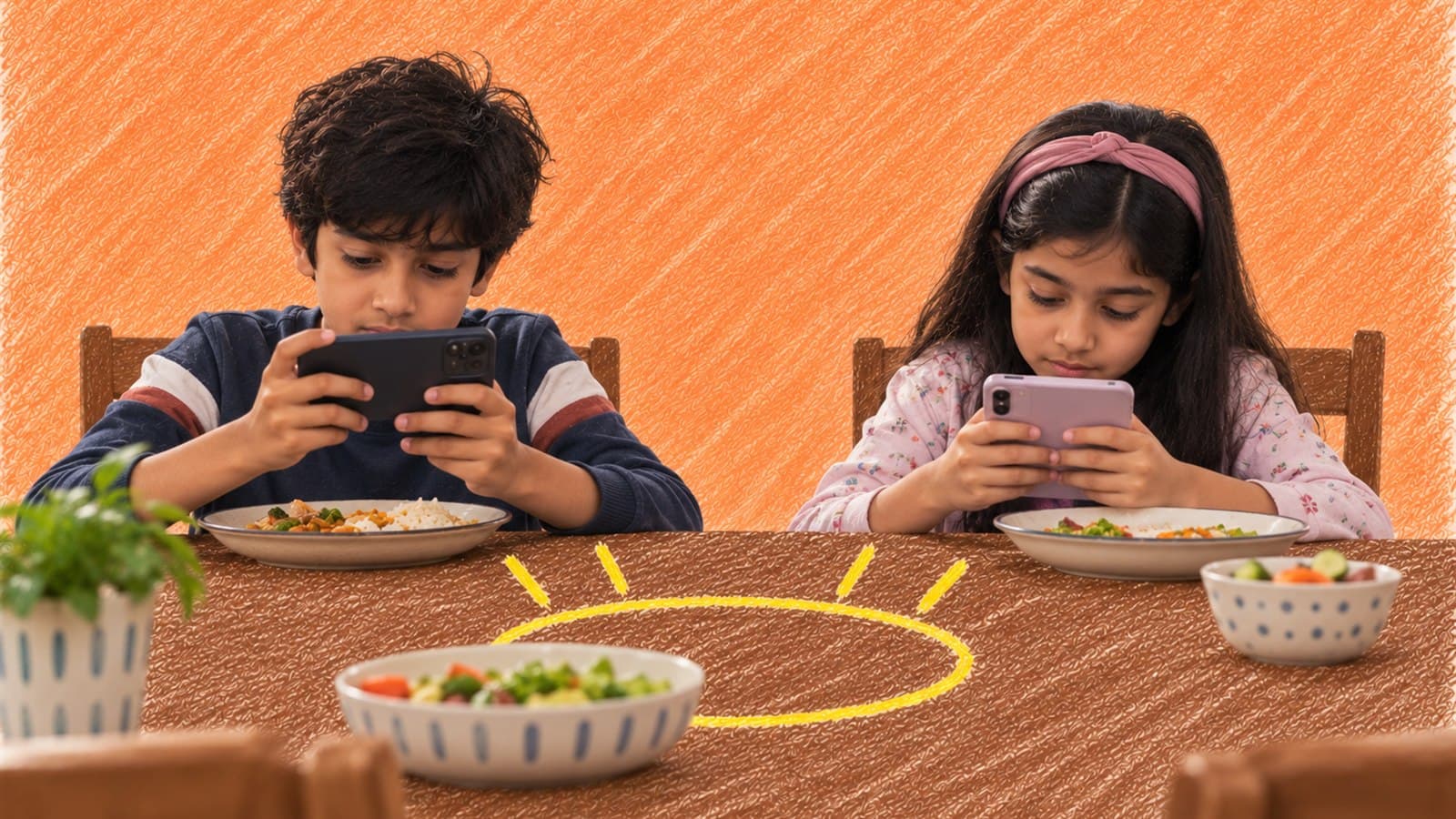
But the phase didn't pass. The phase became the routine. And now your 6-year-old will not eat a meal without a screen in front of them. Attempts to remove it produce a meltdown of such intensity that you've stopped trying. At least they're eating.
You didn't do this carelessly. You did it because you were exhausted and it worked. The problem isn't that you made a bad decision, it's that the short-term fix became a long-term habit. And habits are harder to undo than decisions.
How the mealtime screen habit forms, and why it sticks
Young children learn through repetition and association. When the same thing happens in the same context enough times, the brain links them: mealtime and screen become a single mental unit. The screen is not a reward that accompanies the meal. It becomes, in the child's mind, a part of the meal itself.
This is why removing the screen produces such a strong reaction. From the child's perspective, you haven't just taken away entertainment, you've removed part of the expected experience of eating. Their brain is genuinely confused and distressed, in the same way an adult would feel if someone removed the chair from under them while they were trying to sit down.
The habit also sticks because it works for parents. A child who eats calmly in front of a screen is infinitely easier to manage than a child who doesn't eat at all. In a dual-income household, in the middle of a weeknight, after a full day of work, the screen-at-dinner solution is practically irresistible. There is no judgment in acknowledging this. The problem is that what works in the short term makes the longer term harder.
What it's actually doing, beyond the obvious
Beyond the habit itself, there are a few specific effects of eating with screens that are worth understanding.
Distracted eating and hunger cues
When a child eats in front of a screen, they are not paying attention to their food. This sounds trivial, but the research suggests it matters. Children who eat while distracted are less aware of their own hunger and fullness signals, they tend to eat more than they need, or eat without registering the experience at all. Over time, this can disrupt a child's natural relationship with food and eating.
The lost conversation window
For most urban Indian families, the dinner table is one of the few moments in the day when the family is together and not actively doing something else. A child who eats in front of a screen is not having that conversation. Over the years, those lost conversations add up to a significant gap in the parent-child relationship, and a child who hasn't learned to sit at a table and talk, which is a skill that requires practice like any other.
The habit generalises
A child who learns that eating requires a screen will eventually start applying that association to other activities. Quiet time, car journeys, waiting, every experience of mild boredom becomes an occasion to demand the screen. The mealtime habit is often the beginning of a broader pattern of screen dependence that becomes much harder to address later.
Why taking it away suddenly doesn't work
The most common approach parents try is the cold-turkey removal. One day, the screen simply isn't there at mealtime. What follows is predictable: refusal to eat, meltdown, eventually capitulation or a very unpleasant meal.
This approach fails for two reasons. First, it doesn't give the child's brain any alternative to fill the gap that the screen occupied. The brain that expects a screen at mealtime needs something to replace it, not just an absence. Second, it feels to the child like a punishment rather than a change, which triggers resistance rather than adaptation.
The parents who successfully break this habit almost never do it through sudden removal. They do it through gradual replacement.
What actually works, a step-by-step approach
Step 1: Don't start with removal. Start with reduction.
The goal in the first week is not a screen-free meal. The goal is a shorter screen meal. If dinner currently involves 30 minutes of YouTube, start with 20. Then 15. Then 10. Then five minutes at the end of the meal as a transition. The brain adapts to gradual change far more successfully than abrupt change.
Step 2: Fill the gap with something specific
The screen at mealtime serves a function for the child: it gives them something to pay attention to other than the experience of sitting and eating. When you remove the screen, you need to replace that function with something else. This could be a conversation starter, a specific question you ask every evening ('what was the funniest thing that happened today?'). It could be a simple game. It could be music playing in the background. The replacement doesn't need to be elaborate. It needs to exist.
Step 3: Prepare them, don't surprise them
Tell your child in advance that mealtime is going to change. 'From tomorrow, we're going to have dinner without the phone for the first part of the meal.' Give them a reason they can understand: 'I want to hear about your day.' Children who are prepared for a change are significantly less resistant to it than children who are surprised by it.
Step 4: Be consistent for 21 days
Research on habit formation suggests that it takes approximately three weeks of consistent repetition for a new routine to begin to feel normal. The first week will be the hardest, expect some resistance, some negotiation, possibly some meals that don't go well. The second week will be easier. By the third week, most children have adapted to the new baseline. The key is consistency: every meal, every day, for three weeks.
Step 5: Don't make it a battle of wills
The most important thing you can do during this period is stay calm and matter-of-fact. 'We're having dinner without the phone tonight', not as a pronouncement, not as a challenge, just as a statement of how things are. Children escalate when they sense that escalation might change the outcome. When you are genuinely calm and consistent, the escalation finds no traction.
A note on grandparents and the Indian household
One of the most common reasons this approach fails in Indian households is inconsistency from other family members, particularly grandparents, who often have a more permissive approach to the child's screen time and may actively undermine the rules you are trying to set.
This is a conversation worth having explicitly, before you begin. Not as an accusation, but as a request: 'We're trying to change how we handle screens at mealtimes, and we really need everyone to be consistent for it to work.' Most grandparents, when asked directly and respectfully, are willing to support a change that they understand the reasoning behind.
The other side of it
Parents who have successfully shifted this habit consistently report the same thing: they miss the easy meal, but they don't miss anything else about it.
What replaces it is something quieter and less immediately dramatic, a child who tells you something about their day that you wouldn't have heard otherwise. A conversation that goes somewhere unexpected. A meal that ends without anyone feeling frustrated.
The screen-free meal is not the goal. The relationship that grows in that space is the goal. The screen-free meal is just the precondition.
Tags:
Screen Time 5, 8 Mealtime Screens Young Children Screens Parenting Habits Digital Wellness India Screen Habits Children