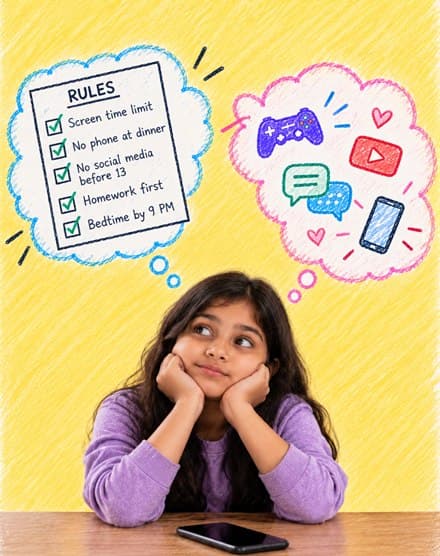

Priya didn't think it was possible. For almost two years, evenings in her Bengaluru home had a predictable shape: her 11-year-old son Arjun on his phone, dinner getting cold, a fight about putting it down, and everyone going to bed frustrated. 'I thought this was just what parenting a child with a phone looked like,' she says. 'I thought I just had to get used to it.'
She hadn't. And three weeks after making some specific changes to how screen time worked in her home, she found herself sitting at the dinner table on a Tuesday evening, phones away, actually talking to her son about his day, and realising that this hadn't happened on a weeknight in as long as she could remember.
“I sat there thinking, is this what other families feel like every evening? Because we haven't had this in two years.”
What the Old Evenings Looked Like
Priya is specific about what the fights were actually like, because she thinks the specificity matters. 'It wasn't one big fight. It was a hundred small ones. Every single evening, multiple times. Put the phone down for dinner. Put the phone down for homework. Put the phone down, it's 9pm. Put the phone down, it's 10pm. By the end of the evening I felt like I had spent the whole night arguing with my own child.'
Her husband Rahul had a different approach, stricter and more confrontational, which led to more resistance from Arjun, which led to a disagreement between Priya and Rahul about how to handle it. 'The phone was affecting our marriage too,' she says. 'It sounds dramatic, but it's true.'
She had tried everything she'd read about. A screen time app that Arjun immediately found a workaround for. A 'phone basket' by the front door that lasted four days. Taking the phone away as a punishment for bad behaviour, which led to worse behaviour and a complete breakdown in trust between them.
What Actually Changed
The first change was the most important one, and it had nothing to do with the phone itself.
'I stopped making myself the enforcer,' Priya says. 'That sounds simple but it took me a long time to understand what it meant. Every time I said put the phone down, I was the bad guy. Arjun's frustration was directed at me. I was in the way of the thing he wanted. That dynamic was poisoning our relationship every evening.'
She set up an automatic screen time limit that cut off at 8:30pm. No negotiation required, no confrontation, no Priya walking into the room and saying anything. The phone simply stopped working for social apps at 8:30pm. 'The first night, he came to me and said the phone wasn't working. I said yes, that's the new rule, it switches off at 8:30. He was annoyed. But he wasn't annoyed at me in the same way. It was different.'
The second change was a 10-minute warning. At 8:20pm, Priya would say, once and calmly, 'ten minutes.' Nothing else. 'I used to say it five times and get increasingly frustrated each time. Now I say it once and walk away. It took about a week for him to start actually winding down when I said it. Now he usually puts the phone down before I say anything at all.'
The Conversation That Changed Things
About a week into the new system, Priya sat down with Arjun on a Saturday morning and had a conversation she describes as the most honest she'd had with her son in years.
'I told him I was sorry that evenings had become such a battlefield. I told him I understood that his friends were online and that the group chats were important to him. I told him I wasn't trying to take that away. I was trying to find a way for everyone to have a peaceful evening. And I asked him what would make the new rules feel fair.'
Arjun asked for one thing: that the 8:30pm limit didn't apply on Friday nights. 'I said yes immediately. It cost me nothing and it meant everything to him. He felt heard. He felt like he had some ownership over the rules. And honestly since that conversation he has been a different child about this.'
“He came home from school the other day and told me about something that happened in his group chat, voluntarily, without me asking. That hadn't happened in months. I think it's because he doesn't feel like I'm the enemy anymore.”
What Three Weeks Looks Like
Priya is careful not to oversell it. 'There are still moments. He still pushes sometimes on a school night. But the baseline has completely changed. Evenings are not a war zone. We have dinner and talk. He does his homework without me having to stand over him. He goes to bed at a reasonable time.'
She notes something she didn't expect: Arjun himself seems calmer. 'He used to be irritable and distracted in the evenings. I think partly because he was always half in a screen, half in the real world. Now when the phone is away, he's actually present. He jokes around. He's more like the child I remember from two years ago.'
She's also noticed something in herself. 'I stopped dreading evenings. That sounds small but it was huge. I used to feel a kind of low-level dread at 7:30pm, knowing what was coming. Now I don't feel that. We just have an evening.'
What She Would Tell Other Parents
'Stop making yourself the enforcer. Use a system to hold the rules so you don't have to. Have the real conversation with your child, not in the middle of a fight, but at a calm moment when you can actually hear each other. And give them something: one concession, one thing that makes the rules feel fair. It costs you almost nothing and it changes everything.'
She pauses. 'Also, and I say this to every parent I know who is going through this, the fight is not about the phone. The fight is about the relationship. Fix the relationship and the phone thing gets easier. I don't know why it took me two years to figure that out.'