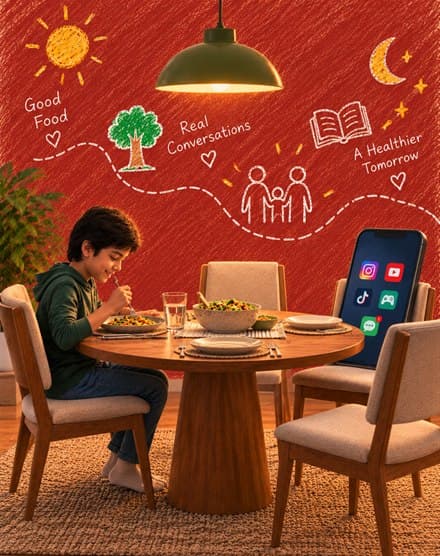

There is a moment, not always visible and rarely dramatic, when a child decides to stop telling their parent things.
It doesn't come after one bad conversation. It builds slowly, across many small interactions, until one day the child does something they're uncertain or ashamed about, weighs their options, and quietly concludes: "It's easier not to say."
We talked to Aradhana, a counselling and rehabilitation psychologist with 26 years of practice across children, adolescents, and families. She is currently pursuing her PhD in adolescent mental health, studying how trust gets built and broken in the parent-child relationship, particularly around screens and digital life.
What she shared was less comfortable than most advice on this topic because it placed the responsibility somewhere many parents aren't expecting. Not on the child. On the conversation.
The Two Ways Parents Break Trust Without Realising It
Aradhana sees the same patterns recurring across almost every family she works with.
Most parents arrive worried about their child's behaviour. Won't listen. Too much screen time. Secretive. Always on the phone.
But when Aradhana maps the history, the rupture almost always traces back to something a parent said or did, often in a moment of genuine frustration, without understanding its downstream effect.
Two things come up more often than anything else.
The first is what she calls "presence versus presence". Handing a child a phone so they stop troubling you. "Take the phone and leave me alone."
The child is happy. The parent gets peace. On the surface, everyone wins. But something quieter happens underneath.
The child learns that when they need attention, a device is the substitute. The lesson lands earlier than most parents realise.
“The first thing parents do wrong is: take the phone and leave me alone. That's the first point of the problem. It's a compensation, what I call presence versus presence. You hand over something, the child is happy, your responsibility is over. Your onus is gone. That's where it starts.”
The second is more direct. And more dangerous.
It's the five words Aradhana says she hears again and again during screen-related arguments: "I can't trust you anymore."
Parents say this because it's how they feel in that moment. They mean it as a consequence. A signal. A boundary.
But to a child, particularly an adolescent whose sense of identity is still forming and whose relationship with their parents remains one of the most important measures of self-worth, it lands as something much larger.
“When a parent says 'I can't trust you anymore,' at the drop of a hat, trust is broken and established as a fact in communication. The child hears: my parents don't trust me. No one trusts me. Nobody loves me. This is the end of my life. Because children have an extraordinary ability to catastrophise whatever is coming their way. They are amplifying everything we say. This is exactly what we need to be sensitive to.”
The parent moves on. The child does not.
Adults often experience a moment. Children experience a message.
Trust, in a child's internal world, is not a sliding scale. It is closer to a switch.
And once the switch has been thrown, once a child has filed away the belief that their parent does not trust them, they act from that belief.
They become less likely to share. More likely to hide. Not out of malice. Out of self-protection.
The 40-Minute Problem
Here is a number that sits uncomfortably.
The average quality time a parent spends with an adolescent has dropped to roughly 40 minutes a day.
Meanwhile, that same child is spending six hours in school, three to four hours in classes or tutoring, and at least an hour online, often with people their parents don't know and can't see.
“Children at a certain stage look for validation from their parents. Instead of being there to give it, we hand over a phone and say: spend your time with this. Your 40 minutes can't compete with that. Obviously, it is going to affect his brain.”
This isn't about guilt. It's about attention.
When a child is spending the largest portion of their day receiving input from sources other than their parents, the parents' influence on how they process the world is genuinely limited.
Not because the parents don't care. Because there isn't enough meaningful connection competing for that attention.
The response is not to panic. And it's not to clear your schedule.
Aradhana is clear on this. It's not the quantity of the time. It's what happens inside it.
“The first thing in parenting is meaningful conversation. Even five minutes can have an impact. But it does not have to be a lecture. And don't ask stupid questions. 'How was your day?' is a stupid question. It will only get a stupid answer. Instead: what exactly did you do today? Tell me something. I had a crazy day. Before I tell you about mine, why don't you tell me about yours? When you set the ball rolling, they catch on. Throw blanks and you get blanks back.”
This is worth sitting with.
The default check-in of "How was your day?" followed by "Fine" is not neutral.
It teaches the child that the parent is going through the motions of connection without genuinely seeking it. Children know the difference.
The question that gets a real answer is the one that suggests the parent is actually curious. Not checking a box. Curious.
Children can tell the difference between interest and obligation.
When You Find Something On Their Phone
At some point in most digital parenting journeys, a parent finds something on their child's phone that worries them.
It might be a conversation. A search history. Content they shouldn't have seen. Contact with someone they don't recognise.
The child doesn't know you've seen it. The next 24 hours are consequential.
Aradhana's advice here is deceptively simple. Before reacting. Before confronting. Before asking. Run three questions through your head.
Try This
Before you say anything to your child about what you've found, ask yourself:
- Is it kind?
- Is it necessary?
- Is it true?
If any of these is a no, rethink your path.
If the child has already had a difficult day at school and comes home to a parent scolding them, they're thinking: "Why am I even living?"
That's the weight of timing. The conversation still has to happen. The question is when. And how.
The three questions are not about avoiding accountability. They're about making sure the conversation actually lands instead of triggering the shutdown that happens when a child feels ambushed or shamed.
The same conversation can go very differently depending on when it happens.
The goal is not to punish. It is to understand. And to leave the door open for the next conversation.
A child who feels ambushed stops talking. A child who feels understood keeps the door open.
Friendly, Not a Friend
One piece of advice that circulates widely, "be your child's friend", is, in Aradhana's view, one of the most damaging things a parent can try to do.
Not because warmth or approachability are wrong. But because the friend framing collapses the authority structure children actually need, even when they're pushing against it.
“You have to be friendly. You don't have to be a friend. You have to be approachable. You don't have to be the yaar slapping the kid on the back and saying aaj chalta hai. The child has to understand you are still the authority. The moment they sideline you, you'll say he doesn't respect me. You started it.”
The distinction matters most when it comes to monitoring.
Parents who have been too permissive and then try to introduce boundaries are often met with resistance that feels disproportionate because the child has been operating without the expectation of authority.
Parents who have been too authoritarian and then try to soften are often met with suspicion.
The middle ground, warm and consistent, is harder to maintain than either extreme. But it is the only one that produces what most parents actually want: A child who trusts them enough to tell them things.
Aradhana tells us about her own father. Army background. Not a man given to displays of warmth. And yet she could discuss anything with him. The trust didn't come from his approachability in the conventional sense. It came from consistency.
Trust does not come from being permissive. It comes from being predictable.
She knew the rules. She knew his codes. She knew what the quiet look meant.
And when she crossed a line, she knew she'd crossed it without him having to spell it out. "After a certain age, he'd say: You're old enough to make your own decisions." That was not permission. It was a warning. And they all knew what it meant. The parent doesn't have to be their child's confidant to be the person they turn to when something goes wrong online. They just have to be safe.
And safe means: Predictable. Non-reactive. And genuinely present when it counts.
When Trust Is Frayed: The First Building Block
If you're reading this and recognising some of these patterns, the offhand comment about trust, the phone-as-babysitter, the check-ins that never quite connect, the obvious question is: Where do you start?
The honest answer is that there are no shortcuts. Trust rebuilds slowly. And through evidence.
A child who has learned that their parent's reactions are unpredictable does not revise that belief after one good conversation.
They watch. They test. They update their model gradually, based on what they observe over time. Children rarely change their minds because of one good conversation. They change them because they see the same behaviour repeated often enough to believe it.
The direction, however, is clear.
It starts with the quality of presence, not the duration. It requires the willingness to ask questions that invite real answers. And then to listen without immediately correcting, fixing, or moralising. Trust, in both directions, is something earned through sustained behaviour. Not announced as a judgement in a difficult moment.
Aradhana puts it simply:
“The whole world is balancing on communication. Whatever the profession, whatever the relationship, if the communication is open, you will survive. And communication has to be kind.”
That's as good a place to start as any.
Trust is not built in the big conversations. It's built in the hundred small ones that come before them.
Where Cybertot Fits Into This
At Cybertot, we think the most important conversation you have about your child's digital life is the one you have with them. We're building tools designed to support that conversation, not replace it.