It started innocently enough. Your child was two, maybe three.
Mealtimes were chaos. Food on the floor. Refusal to eat. Meltdowns that felt impossible to handle after an already exhausting day. Someone handed over a phone. A cartoon came on. The child ate. Peace descended. You told yourself it was temporary. Just until this phase passed. But the phase didn't pass. The phase became a routine. And now your six-year-old refuses to eat without a screen in front of them.
You've tried removing it. The reaction felt wildly disproportionate. You've tried negotiating, that didn't work either. At some point, somewhere between the third argument of the week and a rapidly cooling dinner, you arrived at a practical conclusion: At least they're eating.
When we spoke to counselling psychologist Aradhana Sharma, parenting coach Girish Panicker, and digital wellbeing educator Gurdit Singh Chhabda, they all pointed towards the same underlying idea.
The screen was never the real issue. The habit formed because the screen was doing a job.
What The Screen Is Actually Replacing
Most parents assume the screen is there to keep the child entertained. That's only part of the story. Aradhana describes something deeper happening.
“The first thing parents do wrong is: take the phone and leave me alone. That's the first point of the problem. It's compensation. It's what I call presence versus presence. You hand over something, the child is happy, your responsibility is over. Your onus is gone. That's where it starts.”
Presence versus presence.
It's one of the most useful phrases we've come across. Because it explains why the habit becomes so difficult to undo. The phone isn't replacing boredom. It's replacing attention. The child still has the same need. The screen simply became the thing meeting it. And that's why the habit often spreads beyond the dinner table. The child who learns to reach for a screen during meals often starts expecting one in the car, in waiting rooms, before bed, or whenever life slows down. The meal is usually where the pattern begins. Rarely where it ends.
When A Habit Becomes "The Way We Eat"
Children learn through repetition. Not explanation. If dinner and screens happen together often enough, they stop feeling like two separate things. They become one experience.
A child doesn't think: "I enjoy cartoons while eating."
They think: "This is how dinner works."
That's an important distinction. Because when parents remove the screen, the child doesn't feel like entertainment has disappeared. They feel like something is missing from the meal itself. From their perspective, dinner has changed. And children tend to react strongly when familiar routines suddenly disappear. This isn't manipulation. It's expectation.
The Last Shared Moment Of The Day
One section of our conversation kept resurfacing. Not because it was about screens.
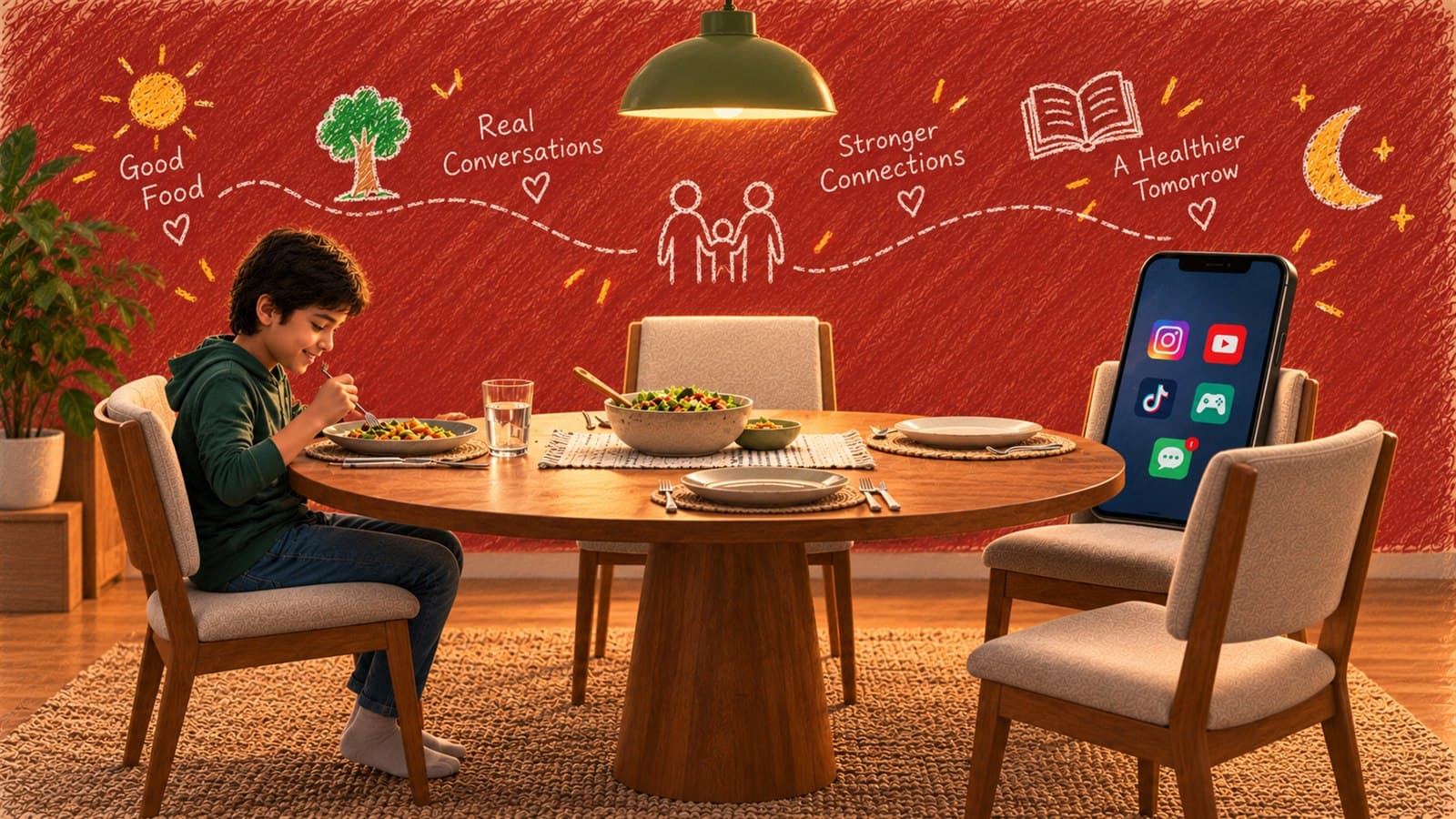
Because it was about families. In many households, dinner is one of the only moments when everyone is physically together. School takes up most of the day. Parents work. Activities fill the gaps. Everyone moves in different directions. The dinner table becomes one of the few remaining places where a family regularly overlaps. Which means the screen at the table isn't just competing with food. It's competing with conversation. Curiosity. Stories. Small moments of connection. The seemingly insignificant things that slowly become a relationship.
The dinner table is not a place. It's a daily practice of being together.
And like any practice, it only works when people participate in it.
Why Most Parents Fail The First Time
The most common solution is also the most predictable.One evening, the screen simply disappears. The child protests.The parent holds firm. The meal becomes unpleasant. The next night everyone arrives at the table remembering exactly how difficult the previous evening was. The screen returns. Not because the parent lacks conviction. Because the change was bigger than expected.
Girish Panicker sees this regularly.
“For small children, you cannot negotiate. The child will not eat for an hour, maybe two. But eventually the body gets hungry and they eat. The question is whether the parent has the patience to hold. Four or five times of the parent actually holding the consequence, the child understands: my parent means what they say.”
The uncomfortable part of this advice is that it requires patience. The encouraging part is that the timeline is usually much shorter than parents imagine. Not months. Not years. A handful of consistent experiences.
What Actually Works
The families who succeed rarely focus only on removing the screen. They focus on replacing what it was doing. Connection. Engagement. Predictability. Something to orient towards. That replacement doesn't need to be elaborate. A family question. Music. A ritual. A story from the day. A game that only exists at the dinner table. The specific activity matters less than the fact that it exists. The screen occupied a space. Something else needs to move into it.
Try This At Home
Tell your child about the change before dinner begins. Not at the table. Earlier.
Try:
"Tonight we're going to eat together without the phone for the first part of dinner. I want to hear about something interesting that happened today."
Then ask a specific question.
Not:
"How was your day?"
Try:
"What was the funniest thing that happened today?"
Or:
"What annoyed you today?"
Specific questions invite real answers. Generic questions usually get generic ones.
The Rule Has To Apply To Everyone
This is where Gurdit's advice becomes important.
“Children won't follow what you say. They follow what you do. If there's a mismatch between those two things, it becomes disrespect. The solution has to be a digital guideline for the entire family, not just rules for the child.”
A screen-free dinner for the child while the adults answer WhatsApp messages is not a family rule. It's a child rule. Children notice the difference immediately. And they're usually right to question it. The phone goes away for everyone. Or the lesson doesn't land.
What Grows In The Space Left Behind
Parents who successfully remove screens from meals rarely tell us they miss them. What they miss is the convenience. The quiet. The certainty that dinner will proceed without resistance. What replaces it is harder to measure. A surprising story. A strange question. A moment of eye contact. A child saying something they wouldn't have said otherwise. These things don't happen every night. But over time they accumulate. And relationships are built through accumulation. Not grand gestures. Small repeated moments. The screen-free meal isn't the goal. It's the space that makes those moments possible.
Where Cybertot Fits Into This
At Cybertot, we believe the habits formed around screens in early childhood are some of the most influential and the most recoverable. The goal isn't perfection. It's intention. Because children won't remember every dinner. But they will remember what dinner felt like. And that's often where family culture begins.