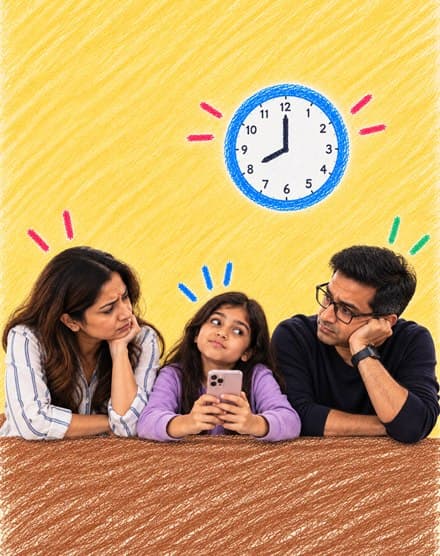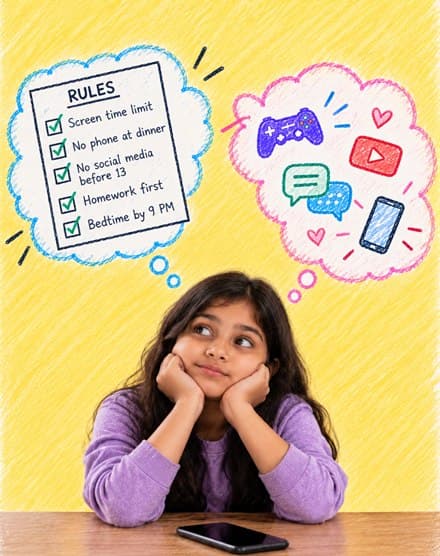

A parent is trying to finish dinner. The phone rings. The dog needs to be let out. A child appears.
Bored. Restless. Demanding attention. The parent does what millions of parents have done before them.
They hand over a phone.
Or a tablet.
Or put on a video.
Not for the evening.
Not for hours.
Just for ten minutes.
The child settles.
The parent gets breathing room.
Problem solved.
Or at least it feels that way.
When we spoke to Aradhana Sharma about screen habits, she said something that stayed with us long after the conversation ended:
The first screen-time mistake rarely looks like a mistake.
It looks like survival.
Why Screens Work So Well
There is a reason parents reach for screens.
They work.
Immediately.
No setup.
No negotiation.
No planning.
No mess.
Few things can capture a child's attention as effectively as a screen.
And when you're trying to get through a busy day, that can feel like a gift.
Most parents aren't using screens because they're lazy.
They're using them because modern life is demanding.
Work follows us home.
Messages never stop.
Schedules are packed.
The screen becomes one more tool that helps keep everything moving.
That's what makes this conversation difficult.
Because the problem isn't that screens work.
The problem is that they work so well.
The Parenting Shortcut Nobody Talks About
Aradhana has a phrase for this.
She calls it presence versus presence.
“Take the phone and leave me alone. That's the first point of the problem. It's a compensation. It's what I call presence versus presence. You hand over something, the child is happy, your responsibility is over. Your onus is gone. That's where it starts.”
It's a confronting observation.
Not because parents don't know it happens.
Because they do.
Most can immediately think of ten moments when they've done exactly this.
The screen steps in when the parent can't.
And once a solution works, we naturally return to it.
Children do this.
Adults do it too.
The Problem With "Just This Once"
Habits rarely arrive with a grand announcement.
They build quietly.
One car ride.
One restaurant meal.
One grocery store visit.
One work call.
One difficult afternoon.
One tired evening.
Then another.
And another.
The issue isn't any single moment.
The issue is repetition.
A child begins to learn something.
When I'm bored, I get a screen.
When I'm waiting, I get a screen.
When adults are busy, I get a screen.
When I'm uncomfortable, I get a screen.
Nobody teaches this lesson directly.
But children are excellent pattern detectors.
They don't need instructions.
They notice what happens consistently.
What starts as a distraction can slowly become an expectation.
Boredom Used To Have A Job
This is the part many adults forget.
Boredom is not a problem to be solved immediately.
It's a skill.
For generations, boredom forced children to invent games.
Build things.
Daydream.
Explore.
Argue with siblings.
Read.
Create.
Not every moment was stimulating.
And that was okay.
Today, boredom has competition.
A screen can remove it in seconds.
Which means children get fewer opportunities to practise sitting with it.
The result isn't that screens are bad.
The result is that boredom becomes unfamiliar.
And unfamiliar things often feel uncomfortable.
When A Screen Becomes The Automatic Answer
Most parents don't need to worry about the occasional cartoon.
Or a tablet during a long flight.
Or a video while dinner is being made.
The question worth asking is simpler:
What happens every time there's a gap?
Every waiting room.
Every car ride.
Every queue.
Every moment of boredom.
Every difficult emotion.
If the answer is always a screen, that's worth paying attention to.
Not because addiction is around the corner.
Because habits are being formed.
The child is learning what to reach for when life slows down.
The Guilt Trap
Whenever this topic comes up, parents tend to swing towards guilt.
That misses the point.
This isn't about being perfect.
No parent is available every minute of every day.
No parent gets this right all the time.
The goal isn't to eliminate screens.
The goal is to notice when they become the default solution.
Awareness matters more than perfection.
Because once you notice a pattern, you have the ability to change it.
A Better Question To Ask
The next time your child asks for a phone or tablet, pause for a moment.
Not to say yes.
Not to say no.
Just to ask:
"What is this screen replacing right now?"
Sometimes the answer will be boredom.
Sometimes it will be attention.
Sometimes it will be convenience.
Sometimes it will be nothing at all.
But it's a useful question.
Because the answer tells you far more than the number of minutes on a screen-time report.
Where Cybertot Fits Into This
At Cybertot, we believe healthy digital habits are built long before a child gets their first phone.
They are built in the small everyday moments that shape expectations.
The goal isn't raising children who never use screens.
It's raising children who don't need a screen every time life becomes quiet, slow, boring, or uncomfortable.
Because the habits that matter most are rarely built all at once.
They're built one "just this once" at a time.