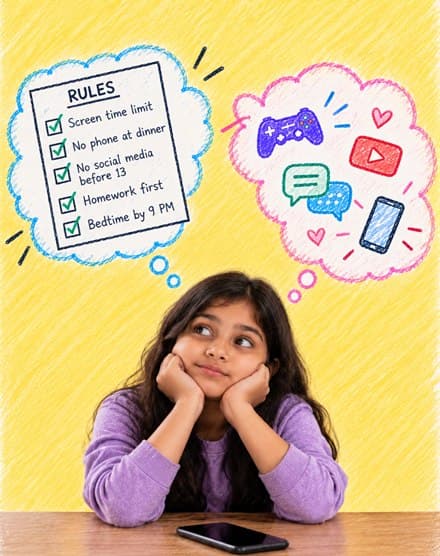

One of the most common fears parents have about screens sounds something like this:
"If I restrict them now, won't they just binge later?" It's a reasonable question. We've seen it happen with food. With freedom. With strict rules. The more forbidden something becomes, the more attractive it can seem. So what about screens? If we make them scarce, do children simply want them more? When we spoke to Aditya and Garima, we expected a conversation about limiting screens. Instead, we found ourselves discussing something far more interesting: Why some children seem surprisingly uninterested in them.
Screen Conflict Is Not What Most Parents Think
Many families treat screens as the problem. The phone is the enemy. The tablet is the distraction. The television is the battle. Garima sees it differently.
“Screen conflict is not really a battle between a parent and a device. It's a competition between the device and everything else the child's day contains.”
That idea changes the conversation. Because if screens are competing against boredom, loneliness, disconnection, or a lack of meaningful alternatives, they have a huge advantage. They're designed to win. But if they're competing against connection, creativity, play, community, movement, and belonging, the equation starts to look very different.
The question becomes: What else is available?
The Child Who Isn't Asking
One of the things Garima noticed while raising their son, Vedas was that screens weren't creating the battles she had expected. Not because they were banned. Not because they were treated as dangerous. But because they weren't filling a gap.
“We were spending so much time with him, filling his cup with emotional connection, that he wasn't asking.”
This isn't about keeping children entertained every minute. It's about recognising that screens often step in where something else is missing. Connection. Attention. Engagement. Belonging.
If those needs are consistently being met elsewhere, screens lose some of their power. Not all of it. But enough to matter.
The Difference Between Control And Understanding
Many parents focus on control. How much time? How many apps? What age? What limits? Those questions matter. But they're only part of the picture. Eventually every child grows older. Eventually they get access. Eventually they encounter technology without supervision. At that point, rules alone stop working. What matters then is understanding. Why does this app exist? What is it trying to make me do? How do I feel after spending time here? Is this helping me or just filling time? Children who understand those questions carry them into adulthood. Children who only experience restrictions often don't.
When A Rule Becomes Your Child's Idea
One of the most surprising stories from our conversation involved Vedas. At one point, he thanked his father for not giving him a screen earlier in life. Not because he had been instructed to say it. Not because he was repeating a family talking point. Because he had reached that conclusion himself. That moment matters. Because it represents something every parent hopes for. Not compliance. Internalisation. The belief no longer belonged to the adults. It belonged to the child.
The strongest values are not the ones children repeat.
They're the ones they eventually arrive at themselves.
The Remote Control Experiment
Cybertot co-founder Karan shared a story that illustrates this beautifully. His daughter Myra was watching television. Like many parents, he wanted her to stop. The usual reminders weren't working. So he tried something different. Instead of taking control, he handed her the remote. He told her she could switch it off when she felt ready. A few minutes later, she did. The rule hadn't changed. The ownership had. Children often resist control. They are far less resistant to responsibility.
The Goal Is Not Self-Control
At least not immediately. The goal is self-awareness. Because self-control grows from self-awareness. A child who understands what a screen is doing to them is in a stronger position than a child who simply follows rules.That understanding develops slowly. Through conversations.
Through trust. Through observation. Through experience. And yes, sometimes through making mistakes. The long-term goal isn't raising children who avoid screens. It's raising children who can navigate them.
So Does Restricting Screens Make Them More Appealing?
Sometimes. Especially when restrictions exist without explanation. Especially when screens become mysterious, powerful, and forbidden. But healthy boundaries don't create obsession. They create context. And context helps children understand why a boundary exists in the first place. That's a very different thing from simply saying no.
Where Cybertot Fits Into This
At Cybertot, we believe the goal of digital parenting is not control. It's capability. Rules matter. Boundaries matter. But the strongest digital habits emerge when children understand the reasoning behind them. Because one day there won't be parental controls. One day there won't be reminders. One day the decision will belong entirely to them. The real question is whether they'll know how to make it.
The goal isn't raising children who follow screen rules.
It's raising children who eventually understand why those rules existed in the first place.