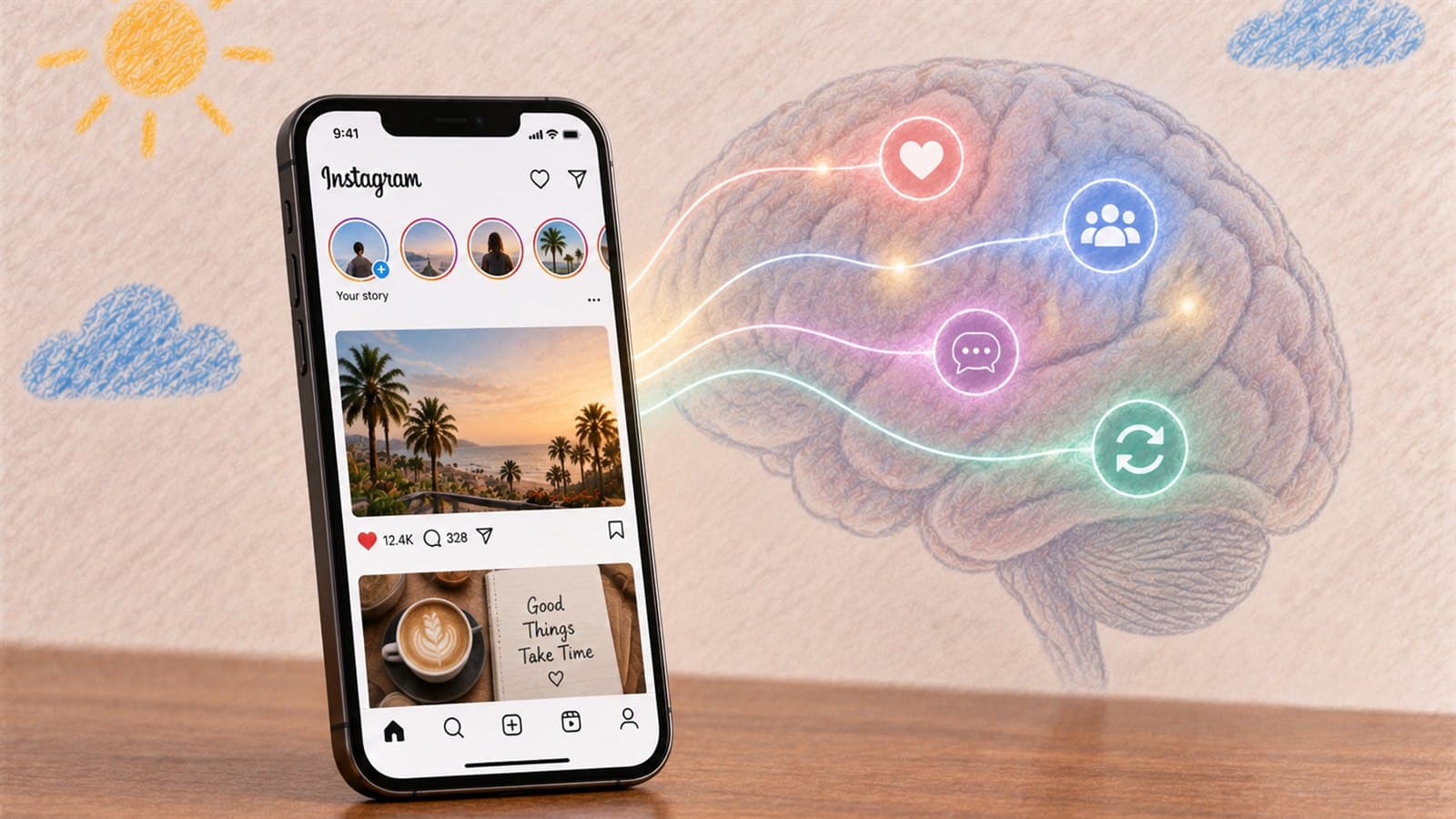
Your 14-year-old picks up her phone the moment she wakes up. Before brushing her teeth, before saying good morning, before anything, she's on Instagram. She checks it at breakfast. She checks it in the bathroom. She checks it the moment she gets home from school, and again at 11pm when she's supposed to be asleep.
You've told yourself this is normal. That every teenager does this. That you did your own version of it, passing notes, talking on the phone for hours, obsessing over what your friends thought of you.
But something feels different. You've noticed it. The mood shifts after a long scroll. The irritability when you ask her to put it down. The way she seems to need the phone the way she once needed a hug.
You're not imagining it. Something genuinely different is happening, inside your child's brain.
First, understand what Instagram is actually designed to do
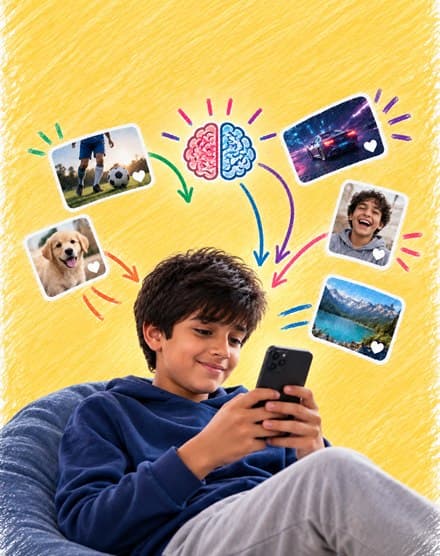
Instagram, like every major social media platform, is engineered around a single psychological mechanism: variable reward. This is the same principle that makes slot machines so effective. You don't know what you'll find when you open the app. Sometimes it's something that makes you feel great. Sometimes it's nothing, or worse, something that makes you feel left out.
The unpredictability is the point. It's what makes you keep coming back.
For adults, this mechanism is powerful enough to make us check our phones 80 times a day on average. For a 14-year-old whose brain is still developing, whose sense of identity is still forming, and whose entire social life now runs through this app, the effect is significantly more intense.
What's actually happening in a teenager's brain
The adolescent brain is not a smaller version of an adult brain. It's a brain in the middle of the most significant period of rewiring it will ever experience, a process that won't be complete until the mid-twenties.
During this window, two systems are in permanent tension:
The reward system, the part of the brain that seeks pleasure, novelty, and social approval, is running at full power during adolescence. It is more active in teenagers than at any other point in life.
The prefrontal cortex, responsible for impulse control, long-term thinking, and regulating emotions, is still under construction. It won't be fully developed until around age 25.
Instagram is a platform designed to stimulate the reward system at maximum intensity, in a brain that has almost no braking mechanism.
The three specific ways Instagram affects teenagers differently from adults
1. The comparison trap hits harder when identity is still forming
Adults compare themselves to others on Instagram too. But adults have a relatively settled sense of who they are. A 38-year-old who sees a peer's holiday photos and feels a twinge of envy moves on. Her sense of self isn't threatened by it.
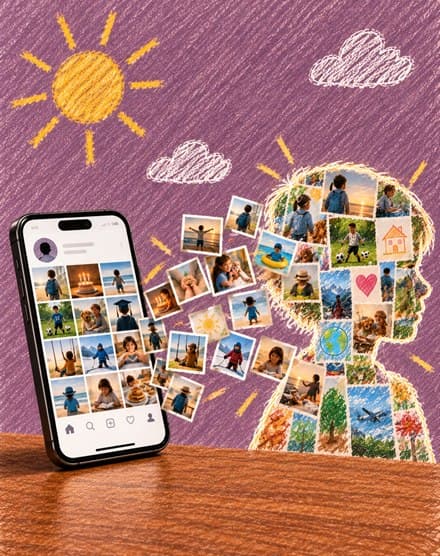
A 14-year-old is in the middle of figuring out who she is. Her identity is being actively constructed, through her friendships, her interests, how she looks, how others perceive her. Instagram feeds directly into this construction process.
When she sees a classmate's photo with 200 likes and 30 comments calling her beautiful, and her own photo got 18 likes, that's not just envy. That's data she's using to understand her place in the world. Her value. Her belonging.
Research published in Psychological Medicine tracked children over ten years and found that social comparison on social media during adolescence is directly linked to lower self-worth, increased anxiety, and depression, particularly in girls. The effect was strongest between the ages of 13 and 16.
2. The social threat is existential at this age
For adults, being left out of a social event is uncomfortable. For a teenager, it can feel life-ending. The adolescent brain processes social rejection in the same neural regions that process physical pain.
Instagram makes social exclusion visible in a way that was never possible before. In previous generations, if your group of friends went somewhere without you, you might find out on Monday. Now, you find out in real time, through a Story that disappears in 24 hours but leaves a mark that doesn't.
3. Approval-seeking becomes chemically reinforced
Every time your child posts something and gets a positive response, her brain releases dopamine. Every time she posts and gets silence, or fewer likes than expected, there's a cortisol response. Stress. The physical feeling of social threat.
Over time, this creates a loop: post, wait, check, feel relief or anxiety, repeat. The checking behaviour becomes compulsive not because your child has no willpower, but because her brain has been trained to seek the dopamine hit and avoid the cortisol spike.
This is why telling a teenager to 'just put it down' is largely ineffective. You're asking her to voluntarily walk away from a machine that is actively triggering her brain's deepest social survival circuits.
What this looks like at home, and what it actually means
She gets quiet and withdrawn after a long scroll. This is often a cortisol response, she's seen something that triggered comparison or anxiety, and her brain is processing it as a low-grade threat.
She gets irritable when you ask her to put the phone down. This is the neurological response to interrupting any reward-seeking behaviour. The irritability is not disrespect, it's biology.
She can't fall asleep until she's checked Instagram one more time. The blue light suppresses melatonin. But beyond the physical, her brain is still in social-monitoring mode at midnight. Sleep requires the brain to downshift. Instagram keeps it in high gear.
The Indian context: why this is more intense here
In urban Indian families, several factors amplify what Instagram is already doing to the teenage brain.
Academic pressure and social media make an exhausting combination. A 14-year-old managing board exam prep, tuition classes, and the social pressures of Instagram carries a cognitive and emotional load that previous generations simply didn't face.
The comparison isn't just local anymore. Indian teenagers on Instagram are comparing themselves not just to classmates but to curated, filtered, internationally-influenced images of beauty, success, and lifestyle. The gap between their real lives and what they see on screen is larger and harder to contextualise.
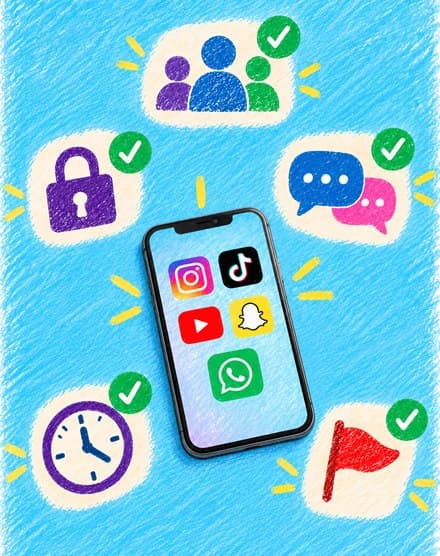
The group chat dynamic. In India, social life among teenagers runs almost entirely through WhatsApp groups. Instagram and WhatsApp together create a 24-hour social surveillance system that is very difficult to step away from without feeling like you're losing your place in your peer group.
What you can actually do, the honest version
There is no simple fix. Anyone who tells you otherwise is selling something. But there are things that genuinely help.
1. Understand before you restrict
The most counterproductive thing you can do is take Instagram away without a conversation about why. To a teenager, an unexplained restriction reads as distrust, and distrust damages the one thing that will actually keep her safe: her willingness to talk to you when something goes wrong online.
2. Timing matters more than total time
Research consistently shows the damage isn't just in the hours, it's in when those hours happen. Late-night Instagram use, specifically between 10pm and midnight, has the strongest correlation with anxiety, poor sleep, and depressive symptoms. A phone-out-of-the-bedroom rule at 9:30pm is arguably more impactful than any total time limit.
3. Watch the mood, not just the clock
The question isn't 'how many hours is she on Instagram?' It's 'how does she feel after she's been on Instagram?' A teenager who uses Instagram for 45 minutes and comes away energised is in a different situation from one who uses it for 45 minutes and comes away deflated. The emotional effect is the real metric.
4. Build something that doesn't require Instagram's validation
The teenagers who navigate social media most healthily have something in their lives, a sport, an art form, a close friendship, an area of genuine competence, that gives them a sense of worth that doesn't come from likes.
5. Keep the conversation open
The most important thing you can do is make sure your teenager will tell you when something on Instagram has hurt her. That requires that she trusts you not to overreact, not to immediately confiscate the phone, and not to make her feel foolish for caring about social media.
The bottom line
Instagram is not inherently evil. It is a platform built for adults, running on psychological mechanisms that are particularly powerful in the teenage brain, in a period of development when those mechanisms cause the most significant harm.
Your child is not weak for finding it compelling. She is not superficial for caring about likes. She is a 14-year-old with a developing brain that is doing exactly what it's designed to do.
Your job isn't to fight her brain. It's to understand it well enough to help her navigate a world that was built to exploit it.