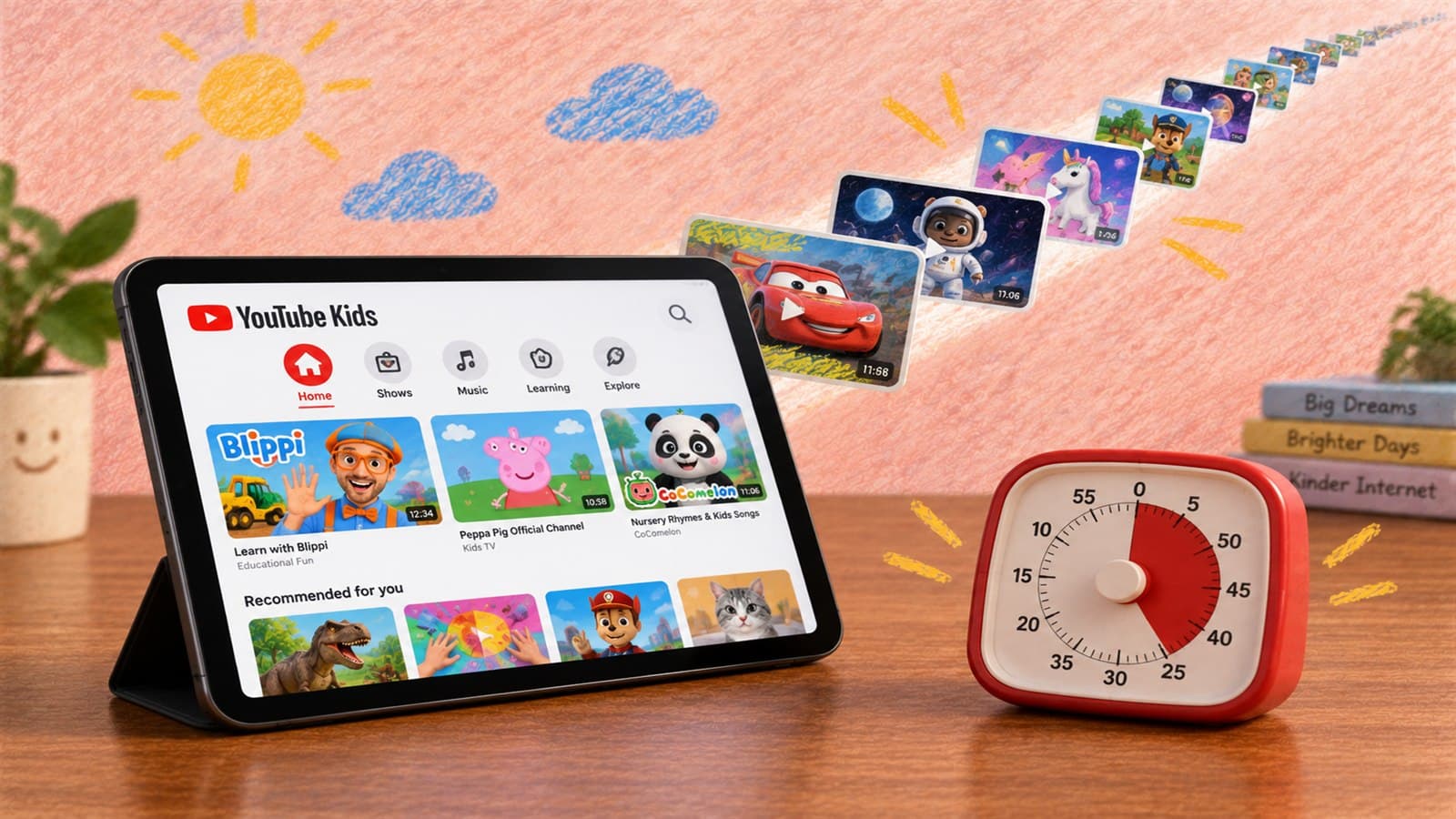
YouTube Kids arrived in most Indian households as a relief. It promised filtered content, age-appropriate viewing, and a safer experience than regular YouTube. For parents managing a young child and a full day's worth of everything else, it delivered on that promise. The chaos reduced. The child was occupied. The content was at least notionally supervised.
What most parents did not get with the app was a briefing on how it actually works. And that gap matters, because YouTube Kids and the television we grew up with are built on fundamentally different principles. Understanding the difference is the beginning of managing it well.
What Makes YouTube Kids Different From TV
Children's television, as most parents in India experienced it, had a rhythm. Programmes aired at fixed times. Episodes ended. There were gaps between content and natural points at which watching stopped. Even heavy viewing had structure built around it.
YouTube Kids has none of that structure. There is no schedule, no natural end point, and no gap between one video and the next. What plays after is determined by what the child just watched, and it is chosen to keep them watching. Common Sense Media research on children's media habits has documented how the shift from scheduled viewing to continuous on-demand consumption is one of the most significant changes in how children experience media, and how much of it they consume.
Nirali Bhatia, a cyber psychologist and founder of CyberBAAP, the anti-cyberbullying not-for-profit, explains what is happening at a psychological level:
Aradhana, a counselling and rehabilitation psychologist with 26 years of practice and a current PhD in adolescent mental health, adds the neurochemical layer. Passive screen consumption is a dopamine loop, and dopamine is a chemical that escalates:
This is why a child who has been watching YouTube Kids for an hour is often harder to pull away from it than a child who has been watching for twenty minutes. The longer the session, the deeper the loop, and the more disruptive the stopping feels.
Why Children Can't Tell When They've Had Enough
One of the things parents most consistently notice is that their child seems unable to self-regulate on YouTube Kids. They never voluntarily stop. They escalate when asked to stop. They seem genuinely unable to identify when they've had enough.
Nirali's research into mental fatigue explains why. Physical fatigue is easy to identify: you are sweating, your legs are heavy, your breathing has changed. Mental fatigue sets in later and is far less visible to the person experiencing it.
The platform is designed to benefit from this. There are no natural pauses, no cues to stop, and no friction between videos. A child who is mentally fatigued but cannot identify the fatigue will keep watching because the screen keeps offering something new. The irritability parents see when they intervene is not stubbornness. It is a fatigued brain being interrupted in a reward state.
The child cannot tell when they have had enough because the platform was specifically built so they never feel that way.
Five Practical Approaches That Change the Dynamic
1. Turn off autoplay first
This is the single most important setting on YouTube Kids and the one most parents have never changed. Autoplay removes the gap between videos entirely, which is what turns a watched video into a continuous stream. Turning it off does not limit what the child can watch. It reintroduces the pause between videos that older television naturally provided. The child has to actively choose the next video rather than being carried into it.
On YouTube Kids, the setting is under Settings > Autoplay. Turn it off for each child profile. It takes thirty seconds.
2. Use a pre-committed time limit, not a warning during viewing
Nirali's recommendation for adults applies equally to children: do not try to identify the moment to stop during the activity, because the brain in the middle of a dopamine loop cannot make that assessment reliably. Set the time limit before the session begins.
For younger children, this works best as a visible timer rather than a parental instruction. A timer on the kitchen counter, a countdown on a shared device, or a parental control setting with a hard stop all communicate the same thing: the time is finite and the limit is the system, not a decision being made by a parent in the moment.
3. Ask about the content, not the time
Aradhana draws a distinction between volume and quality that changes how parents should think about YouTube Kids monitoring. Three hours of structured, varied content is a different neurological experience from three hours of algorithmically similar shorts. The question worth asking is not how long your child has been watching, but what they have been watching and whether they could tell you anything about it afterwards.
A child who can describe what they watched, has a question about it, or wants to try something they saw, has had a qualitatively different experience from a child who watched for the same duration but cannot recall what came on. Building the habit of a short conversation after screen time is one of the simplest ways to understand what the experience actually was.
4. Give the child agency at the point of stopping
Enforcing a stop externally, by taking the device or closing the app, consistently produces a stronger reaction than allowing the child to stop themselves. Karan, co-founder of Cybertot, describes a moment with his daughter Myra that illustrates this. Instead of switching the TV off during a meltdown, he handed her the remote and told her she could turn it off when she was ready.
"Within two to four minutes, she turned it off herself. And when she did, I said: Myra, you're the best. That smile on her face, she was in control. That was the thing."
The principle is that a child who chooses to stop experiences the stop differently from a child who has the stop imposed on them. Aradhana calls this selective listening: offering choices within boundaries the parent has already set, so the child experiences ownership over the outcome. The boundary is the same. The child's relationship to it is different.
5. Treat YouTube Kids as one part of the day, not an available background
The pattern that causes most difficulty with YouTube Kids is not extended watching sessions. It is the gradual blending of the platform into everything: meals, the gap between activities, waiting time, background noise while other things happen. When the platform is always present, it becomes the default state, and the negotiation required to remove it from any given moment is a daily conflict.
Building in specific windows for YouTube Kids, and keeping other parts of the day genuinely screen-free, gives the child a framework rather than a series of ad hoc restrictions. The boundary is easier to hold when it is structural rather than situational.
The Conversation Underneath All of This
All five approaches above work better when the child understands something about why they exist. Nirali's most consistent recommendation for parents introducing any kind of digital limit is to have the conversation first rather than imposing the change and explaining afterwards. A child who understands that their brain needs pauses, and that the platform is designed to prevent those pauses, is a child with a reason for the rule rather than just a rule.
Aradhana suggests framing it in terms of the child's own experience rather than parental authority: have you ever noticed that you feel grumpy after a long screen session? That is your brain being tired. The limit is not about the screen being bad. It is about your brain needing to rest so it can do everything else well.
That conversation will not resolve everything. Children will still push back. But a child who has been offered an explanation in good faith, and who has some ownership over the structure, will push back less. And over time, they will begin to recognise the signals themselves.
The goal of managing YouTube Kids is not to eliminate the thing they enjoy. It is to make the boundaries legible enough that the child eventually internalises them.
At Cybertot, we built tools that hold screen time limits automatically, so the system enforces the boundary rather than the parent doing it in the middle of each session. For YouTube Kids specifically, the timer and content settings work together to create the pauses that the platform is designed to remove.