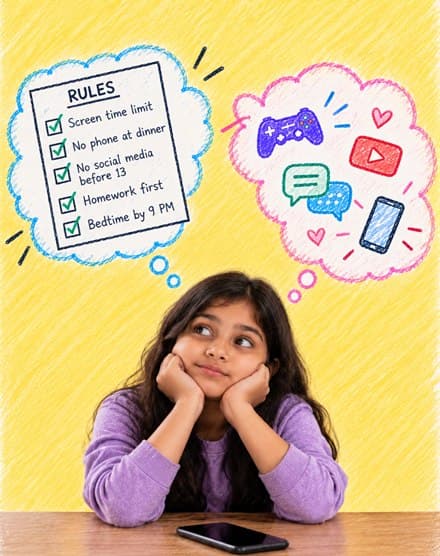

A child asks one adult for screen time.
They say no.
So the child walks to another room and asks someone else.
And eventually, someone says yes.
Not because the family is careless.
But because modern parenting rarely happens between just two people anymore.
Today, children are often being raised inside entire ecosystems:
- parents,
- grandparents,
- older siblings,
- caregivers,
- extended family,
- and sometimes even multiple homes.
And when every adult has a different definition of:
- "too much screen time,"
- "bad behaviour,"
- or "normal,"
children receive mixed signals very quickly.
The issue is not that children are manipulative.
It is that children are extremely good at identifying inconsistency.
The real problem is usually not the child
According to parenting coach and counsellor Girish Panicker, most families approach behavioural struggles backwards.
The child becomes "the problem."
The tantrum. The attitude. The screen addiction. The disrespect.
But Girish argues that children are usually doing something much simpler:
They are learning the environment around them.
“A child is constantly experimenting with life. The real difference comes from how the adults respond to that behaviour." says Girish Panicker Parenting Coach & Certified Counsellor”
And while older family systems often had clearer authority structures, modern parenting tends to involve more negotiation, emotional openness, and multiple caregiving voices.
That shift has many positives.
But it also means children can sometimes receive:
- inconsistent boundaries,
- mixed consequences,
- and unclear behavioural expectations.
When authority becomes unclear, rules start feeling optional.
Why family-wide consistency matters
One of the strongest patterns Girish sees is families trying to solve behavioural issues privately as if the responsibility belongs only to the mother and father.
But children do not experience family that way.
If grandparents, older siblings, caregivers, or relatives are regularly involved in the child's life, they become part of the behavioural environment shaping that child.
Which means:
- they influence routines,
- boundaries,
- consequences,
- and emotional responses too.
“Parenting is not just about the father and mother anymore. Every person who has a parental role in the child's life becomes part of the system influencing that child.”
This is where many families unintentionally struggle.
A child throws a tantrum.
One adult holds the boundary. Another gives in. A third says: "Just let them have it."
The child learns something important immediately: the adults are not aligned.
And once children sense inconsistency, they stop experiencing rules as stable boundaries.
They start experiencing them as negotiations.
Children do not need every adult to be strict.
They need the adults to sound like they are on the same team.
The healthiest rules are agreed on together
Girish strongly recommends involving all key adults in the rule-setting process itself.
Not after the conflict.
Before it.
That includes:
- parents,
- grandparents,
- caregivers,
- and importantly,
- the child too.
Because rules feel very different when children understand:
- why they exist,
- what the consequence is,
- and that every adult understands the agreement.
Try This At Home
Before introducing a new screen rule, sit together as a family and answer three questions:
1. What is the actual rule?
Example: "No phones during dinner."
2. What happens if the rule is broken?
Make the consequence:
- clear,
- calm,
- and predictable.
3. Can every adult in the house realistically support this?
If not, simplify the rule until everyone can follow it consistently.
The goal is not perfect enforcement.
It is shared clarity.
Consequences work best when they are predictable
One of Girish's strongest parenting principles is that consequences should never arrive through emotional outbursts.
Children should know:
- the rule,
- the consequence,
- and the choice they are making.
Before the conflict happens.
“The parent should not become emotionally pulled into the reaction. The rule exists calmly, like rules in any game.”
Because many children are not reacting only to the restriction itself.
They are reacting to:
- inconsistency,
- emotional escalation,
- unpredictability,
- and changing responses from different adults.
Children feel safer around boundaries that stay emotionally stable.
Friendly is healthy. Friendship is different.
Modern parenting advice often encourages parents to "be friends" with their children.
Girish disagrees gently, but firmly.
“You can be very friendly with your child. But you cannot become only a friend. Children still need adults who can hold boundaries calmly.”
- fear,
- harshness,
- or emotional distance.
In fact, Girish believes the opposite.
The healthiest authority comes from adults who can:
- stay emotionally regulated,
- communicate clearly,
- and separate love from consequences.
A child should never feel unloved because a boundary exists.
That is where many families unintentionally struggle.
The consequence becomes emotional:
- anger,
- withdrawal,
- frustration,
- disappointment.
Instead of simply: a rule being held.
The goal is not stricter parenting
This is important.
The solution is not:
- more control,
- more shouting,
- or more punishment.
The solution is reducing confusion.
Because children behave very differently when:
- expectations are predictable,
- consequences are stable,
- and the adults around them feel emotionally aligned.
And perhaps most importantly: when children feel they are still loved even while being corrected.
Consistency creates emotional safety.
Not fear.
Not domination.
Safety.
Where Cybertot Fits Into This
At Cybertot, we believe the healthiest digital habits are built through shared family understanding not daily conflict.
Technology alone cannot create healthy boundaries.
But it can support agreements that families have already made together.
That's why Cybertot is designed not just as a restriction tool, but as a structure tool: helping families create clearer expectations, calmer routines, and healthier digital rhythms across everyone involved in raising a child.
Because children do not grow inside individual rules.
They grow inside systems.
And the strongest systems are the ones where the adults move together.