The Moment a Child Says "I'm Bored", We Panic
The silence lasts maybe thirty seconds. Then we reach for something. A toy. A suggestion. A screen.
It is almost involuntary. A bored child feels like a problem that needs solving. And we have become very efficient at solving it.
But what if boredom is not the problem? What if it is the condition that produces something we are inadvertently taking away?
Aditya left a career in Singapore to raise his family in the Himalayan foothills of Uttarakhand. He and his partner Garima unschool their son Vedas, now six, in a village where days are slow, phones are rarely visible, and unstructured time is not scheduled. It simply exists.
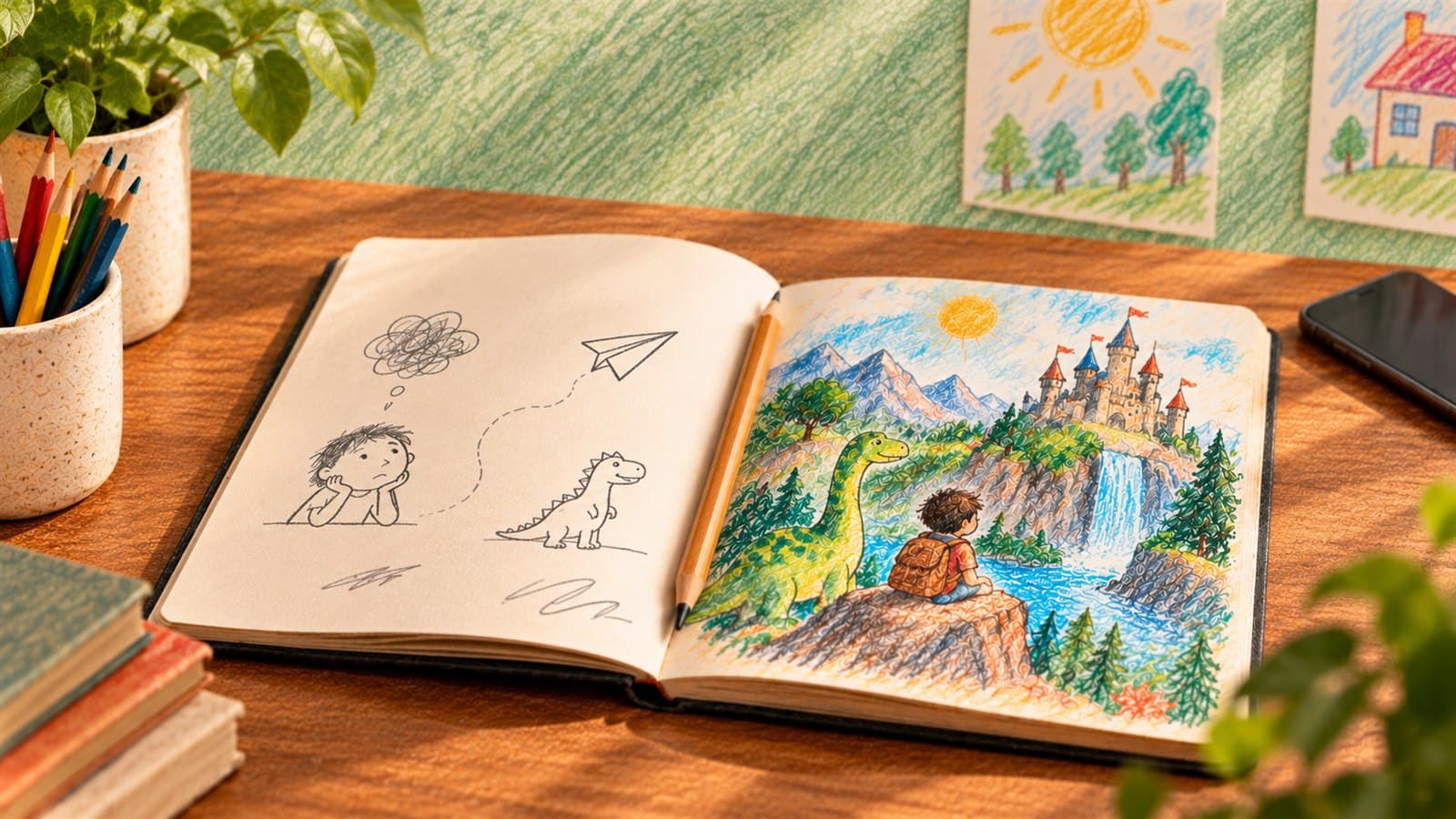
When Vedas is bored, he does not ask for a screen. He builds things. A tractor out of cardboard. A stone house. A mud village, assembled from whatever is around him.
"Every child has that in them," Aditya told us. "You just have to let it happen."
That phrase stayed with us. Let it happen. Don't engineer it by filling the gap in their day before it has a chance to blossom into something unique.
Boredom Is Not Emptiness. It Is the Start of Something
Developmental research is consistent on this: unstructured time is where children practise internal resourcefulness.
The ability to self-direct. To tolerate uncertainty. To generate their own engagement when no one is handing it to them. These are not soft skills at the margins of a child's development. They are the cognitive foundations that everything else sits on.
The child who never sits in boredom never builds the machinery to move through it.
That machinery is what allows a teenager to stay with a difficult problem, to tolerate a slow conversation, to sit with an uncomfortable feeling rather than immediately escaping it. Screen or no screen, that capacity is what parents are ultimately trying to build.
“The moment a child is bored, we want to stimulate their senses. Thankfully, we could see the other side of boredom. How it brings out intrinsic curiosity. How it brings out the creative genius. Because he is bored, he is imagining.”
Screen Time Is Not the Enemy. But It Is a Very Effective Competitor
The reason boredom gets displaced so fast is that screens are extraordinarily good at filling it. Not neutrally good. Engineered to be good.
A phone handed to a restless child is not providing rest. It is providing a continuous stream of stimulus calibrated to hold attention better than almost anything else in that child's environment.
Garima works with families on child brain science and respectful parenting. The way she frames it: screen conflict is not really a battle between a parent and a device. It is a competition between the device and everything else the child's day contains.
When genuine connection is plentiful, the pull toward screens is proportionate. Not because screens are forbidden. Because the child is not hungry for something they are not getting.
"We were spending so much time with him, filling his cup with emotional connection, that he wasn't asking." The cup metaphor is worth sitting with. Children do not reach for screens because screens are irresistible. They reach for them because something else is missing.
Does Withholding Screens Make the Pull Stronger?
This is the question most parents quietly carry. The sugar comparison comes up often: if you never let them have it, they will binge when they finally do. It is a reasonable worry.
Aditya takes it seriously and does not dismiss it. He is also honest about the privilege of their circumstances. Most people in Vedas's village are not on phones much. The social comparison pressure that drives so much of urban children's screen desire simply does not exist in the same way. When the family visits a city and Vedas is with friends who are on phones, they do not intervene. Prohibition is not the strategy.
The strategy is saturation with other things, so that the pull toward screens is proportionate rather than compulsive.
The evidence that this is working is not behavioural. It is something Vedas said, unprompted, to his father. He thanked him for not giving him the screen. Not as a rehearsed line. As a real expression of something he had absorbed through actual conversations about what screens do to time, to attention, to the texture of a day. It had become his own understanding, not an imposed rule.
That is a different kind of protection than any app can offer.
The Remote Experiment: What Happens When a Child Makes the Call
For most families, the Himalayan foothills are not on the table. What is on the table is the underlying principle.
Children who feel in control of their own screen decisions behave differently from children who feel controlled by other people's rules about screens.
Karan, co-founder of Cybertot, tested this on an ordinary morning. His daughter Myra had been watching TV. He needed her to stop. The usual approach, taking over, produced an immediate meltdown. So instead, he handed her the remote. He told her she could turn it off when she was ready. Within a few minutes, she did. And she was visibly proud of herself.
The rule had not changed. The ownership had. She made the call, and that changed everything about how it felt.
Try This At Home
Next time your child has been on a screen for a while, try this instead of switching it off yourself.
- Tell them: "I think you've had enough. When you're ready, you can turn it off."
- Hand them the remote, or the device.
- Wait. Do not hover.
- Notice what happens, and how they feel about themselves when they do it.
We Are the First Generation Doing This, But That Is Not an Excuse
Garima puts it plainly: every time things get hard, the instinct is to ask how our own parents managed it. And then the realisation: there is nothing equivalent to look back to.
A generation that grew up with landlines understood that home meant leaving the social world at the door. That separation was structural. It did not require discipline. Now the phone comes home. School comes home. The algorithm comes home.
The family is never really disconnected. And never really together either.
Aditya draws a longer arc. The industrial revolution damaged the planet before anyone fully understood it. The green revolution reshaped food systems in ways whose consequences took decades to see. The technology revolution is doing something to attention, to solitude, to the internal lives of children, and we are still inside it.
“We are all making our own experiments, and we're our own guinea pigs.”
This is not a counsel of despair. It is a counsel of honesty. Nobody raising children through this moment has a playbook. The research is catching up. The tools are imperfect.
What we can do is stay curious about what is actually happening. Notice when a child is restless and resist the reflex to fill the gap immediately. Create the conditions for boredom to do its work.
A cardboard tractor built by a six-year-old in the mountains is, in its own way, a data point worth paying attention to.
Does something in here connect with your own experience at home? Write to us at social@cybertot.ai. We may feature your story in a future piece, with your permission.