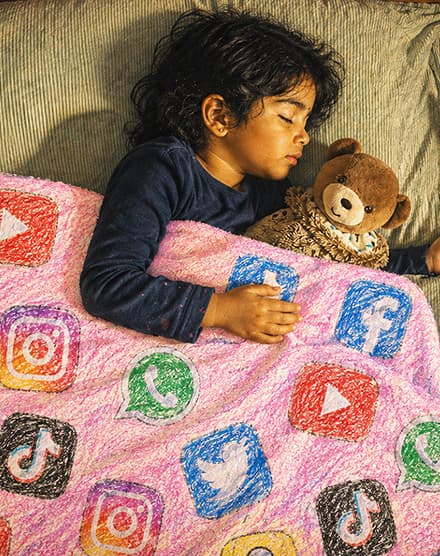
There is a moment most parents will recognize. It usually happens at night. The house is quiet, the kids are finally asleep, and you find yourself holding your child's phone, thumb hovering, wondering whether to open it. Whether to read the messages. Whether that counts as protecting them or spying on them, and whether there is any real difference between the two at eleven at night when you're tired and worried.
We built Cybertot for the person standing in that moment. So we should be honest about what we think that moment is about.
It Was Never Really About the Phone
The story the technology industry tells about children and screens is a story about danger and defense. Children are at risk. The internet is the threat. The parent is the last line of protection. And the tools sold to that parent are built accordingly: more visibility, more alerts, more access, more logs. The unspoken promise is that if you can see everything, you can prevent everything.
Anyone who has actually parented a child knows this is not how it works.
The phone is not the thing you are trying to manage. The phone is where a much older challenge now plays out. You are trying to raise a person who can navigate a world you cannot fully see, using judgment you are still helping them build. That was true before smartphones existed. Parents have always had to let go by degrees, to trade a little control for a little trust, over and over, until the child becomes someone who no longer needs them to. The phone did not change the task. It just moved it somewhere unfamiliar and sped everything up.
Which means the tools that treat the phone as the problem are solving the wrong problem. You can read every message your teenager sends and still have no idea what they're going through. You can track every location and still have a child who won't talk to you. Information is not the same as understanding, and surveillance is not the same as closeness.
What Protection Costs
Here is the part the industry doesn't say out loud. Total visibility has a price, and the child pays part of it.
A child who knows every tap is watched learns to be watched. They get quieter. They get more careful. They find the corners of the internet you aren't looking at, because the instinct to have a private inner life doesn't disappear under monitoring. It just goes underground. The very tool meant to keep them safe teaches them that honesty and protection are opposites.
And the parent pays too. Give a parent fourteen notifications a day and you don't give them peace of mind. You give them a low hum of anxiety that never switches off, plus a nagging guilt about the kind of parent all this watching is turning them into. That guilt is not a flaw in the parent. It is a signal. It is the part of them that knows the relationship matters more than the data.
We decided early that we would design around that signal instead of ignoring it.
What Cybertot Does, and Why We Draw the Line Where We Do
Cybertot sets screen time limits that hold on their own, so bedtime stops being a negotiation. It shows a parent their child made it to school without turning them into someone refreshing a map all afternoon. It filters harmful sites before they load. It flags an unfamiliar contact or a phone moving too fast in a car. The routine, mechanical work of keeping a kid safe online gets done in the background, quietly, so nobody has to think about it.
What Cybertot chose to leave out is just as deliberate. It will not open your child's private messages. It will not analyze their mood from what they type. It will not bury itself so deep on their phone that they can't tell it's there. Every one of those was a real decision, and every one of them cost us a feature we could have advertised.
We used a single test. Will this help a parent and child have a better conversation? A feature that only feeds curiosity, or only quiets worry without creating any genuine understanding, doesn't earn its place. That test threw out a lot of things that would look impressive on a comparison chart. We are comfortable with that, because the parents we build for are not counting features. They are trying to stay close to their kids.
Cybertot is built so the technology holds the boundary and the parent gets to stay the parent. When screen time runs out, the app is the one that says so. Nobody has to fight about it. What's left over is the good part: sitting across from your kid and asking how the day went, and having them answer.
The Strangest Thing We Measure
Most companies want you to need them forever. Retention is the whole game. Ours works the other way.
We measure whether families are starting to need us less. Whether the arguments about screens are fading. Whether a parent and child are talking more easily than they were a year ago. A nine-year-old needs firmer boundaries than a fourteen-year-old, who needs firmer ones than a seventeen-year-old, and the entire point is that those boundaries are supposed to loosen. Trust is supposed to grow. Freedom is supposed to expand. The judgment is supposed to move, slowly, from your hands into theirs.
So Cybertot is designed to fade. Fewer limits as habits form. Fewer alerts as trust builds. Until one day the app is doing so little that keeping it feels unnecessary, because your child has become someone who can carry all of this themselves.
A family that leans on an app forever is a family where something got stuck. A family that outgrows it is a family where the real work took hold.
After the Walk
The device your child holds now will be gone in a few years. The apps on it will be replaced by things nobody has built yet. Every platform we are anxious about today will be old news. What stays is the relationship, and the habits of trust and honesty you build inside it while the stakes are still small.
So the next time you are standing in the kitchen at night with your kid's phone in your hand, notice what you are actually reaching for. It probably is not the messages. It is the reassurance that they are okay, and that they will still tell you when they are not.
Cybertot. Built to be outgrown.